With decades of experience helping to mitigate risk across a wide range of industries, 4Sight Utility Engineers are the perfect partners to keep your project moving forward with confidence.

By the late 1980s, Subsurface Utility Engineering (SUE) had already begun demonstrating its value on transportation projects. The work of pioneers such as Henry “Garon” Stutzman and James H. Anspach had helped establish the technical foundations of the practice, while early projects showed that addressing utility conflicts during design could produce significant savings and reduce construction risk.
At the same time, another series of events was unfolding within the Federal Highway Administration (FHWA). Those events would eventually help carry SUE from a developing practice used by a handful of agencies to a concept recognized throughout the transportation industry.
How Subsurface Utility Engineering Got Its Name
At Garon's company, So-Deep, the senior management team realized that their creation needed a distinctive name. Jim Anspach remembers that: “After much debate, we decided that ‘Subsurface Utility Engineering’ was apt and descriptive. This name was presented to the world in 1989 at the first National Highway/Utility Conference in Cleveland, Ohio.”
When the Federal Highway Administration’s promotion of SUE began in 1991, it was determined by leaders in the Office of Engineering that Subsurface Utility Engineering and SUE were apt names for this engineering practice. They particularly liked “Engineering” in the name and from the very beginning considered Subsurface Utility Engineering to be a professional engineering practice.
Even though Subsurface Utility Engineering was considered to be a perfect name, there was a time when the term “SUE” was in jeopardy. It culminated one day when the FHWA’s Office of Public Affairs was making a video for in-house distribution about Subsurface Utility Engineering. A young woman with much marketing experience and public relations expertise was in charge of the project.
At some point Paul Scott told her that he wasn’t sure if SUE was an appropriate name for an engineering practice. She vehemently disagreed. She said that SUE was a catchy name, whereas Subsurface Utility Engineering was a mouthful, and she strongly recommended that we keep it and use it. The name stayed. It went into the video and everything else after that. And she was so right.
A Hurricane Changes the Course of Events
The Federal Highway Administration (FHWA) began endorsing Subsurface Utility Engineering in 1991. It all began, however, in 1989 at about the same time as SUE was getting its name. The story begins with a hurricane.
Hurricane Hugo slammed into the United States near Sullivan’s Island in South Carolina at about midnight on September 22, 1989. It was one of the strongest hurricanes in South Carolina’s history, and at the time the costliest hurricane ever in the Atlantic Ocean. Hugo’s destruction wasn’t limited to just South Carolina; it also devastated Guadeloupe, St. Croix, and Puerto Rico, and produced hurricane force winds across portions of North Carolina. The Ben Sawyer Bridge connecting Mount Pleasant and Sullivan’s Island, which normally turned from side-to-side to allow the passing of ships, broke from its cables. There was a massive amount of other bridge and roadway damage.

At the time of this event, Paul was working in the FHWA’s Office of Engineering in its Railroads, Utilities, and Programs Branch. Jim Carney, a much-beloved gentleman who used to walk around the office in his sock feet, had just retired and his assistant, Jim Overton, was in charge of the office.
Three other positions in the office were vacant due to laterals or promotions: the secretary, the emergency relief engineer, and the special programs engineer (the special programs were pork barrel projects, many of which were ignored by the DOTs depending on politics in the state). That left Jim Overton in charge, Bob Winans to handle railroads and utilities, and Paul.
Paul’s job at the time was to keep up with Federal-aid regulations, policies, and eligibility pertaining to the more than 100 Federal-aid funding programs in effect. Thus, when the hurricane hit, the office had no one in place to handle emergency relief, which became even more of a problem when the Master of Disaster (i.e., the Secretary of Transportation) went to the Carolinas and promised them everything, whether in compliance with Federal laws and regulations or not.
He got lots of great publicity and actually did a very good job, but it fell to the emergency relief office to find ways to make it all happen. But, as mentioned, the emergency relief office was vacant.
As such, it fell to Jim Overton, the Acting Chief for the Railroads, Utilities, and Programs Branch, to (a) respond to numerous inquiries; (b) review requests for Emergency Relief funding; (c) prepare letters approving or denying the requests; and (d) much more. Paul helped Jim as best as he could, but his greatest value to Jim was filling in for the secretary. Paul was the only one in the office who knew how to type and use the new typewriter with word processing capabilities and there were lots of memorandums and letters that needed to go out.
They were getting overwhelmed. Fortunately, help was on the way.
The Arrival of Jerry Poston
Jerry Poston arrived to take over as Branch Chief. He immediately jumped in to help Jim and to direct the team. Consequently, they got the job done in a timely manner and Jerry recommended Jim and Paul for an award.
Jerry was always very quiet and unassuming with a ready smile and a twinkle in his eye, and he had more than his fair share of what the Army called “command presence.” He would sit in his office most of the day smoking cigarettes and working on various things, but his office door was always open if any ‘worker bees’ with cubbyholes in the big outer room needed help. He would always stop what he was doing, turn away from his work, and give them his full attention. Jim Overton was like that too.
Jerry soon filled the vacant positions and hired a cracker-jack secretary named Cleo Dorsey. Cleo told Paul with a mischievous smile that he was never to touch her typewriter again, so he reluctantly went back to his old job. The experience gave Paul a greater appreciation for the work that Cleo and other secretaries have to do.
A New Focus on Utilities
Jerry Poston, Jim Overton, and Paul had become a close team while working on the emergency relief. About a year later Jerry came to Paul’s cubbyhole one day and told him he had decided to split the railroad and utilities job into two full-time positions and wanted Bob Winans to keep the railroad position and Paul to take the utilities position.
Paul hesitated to do so but Jerry convinced him that it was a great opportunity. Not long after that, early in 1991, Jerry and Jim came to Paul and told him they had something they wanted him to do concerning a new practice being used by the Virginia DOT called Subsurface Utility Engineering.
FHWA's Endorsement of SUE
The FHWA's involvement would become one of the defining moments in the growth of Subsurface Utility Engineering.
At the time, SUE had already demonstrated measurable value through projects such as the Virginia Department of Transportation's Crystal City initiative and other early applications across the region.
The practice had developed terminology, methodologies, quality controls, professional oversight, and documented project savings. Jim Anspach later reflected that FHWA's involvement during the 1990s was one of the major reasons SUE evolved into what it is today.
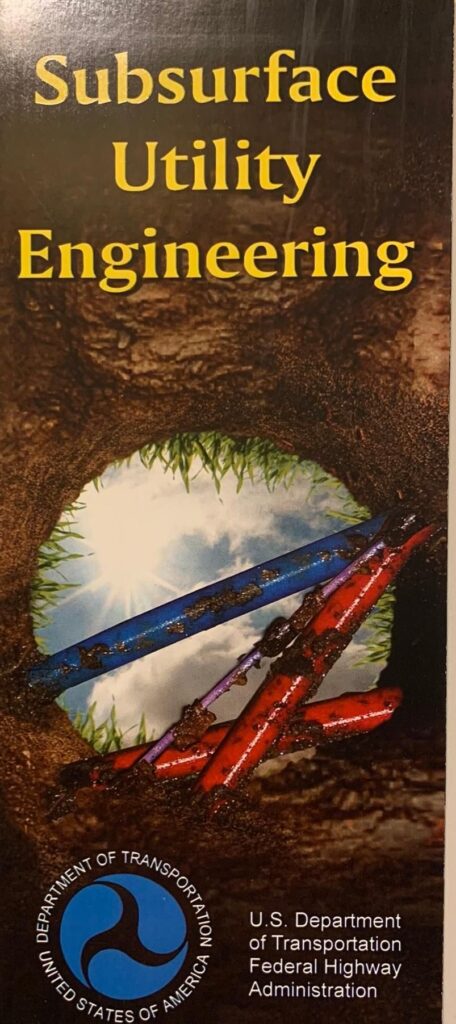
The practice continued moving from an innovative concept developed by a small group of industry pioneers toward a recognized engineering discipline used on infrastructure projects of all sizes.
The Beginning of a New Chapter for SUE
The events surrounding Hurricane Hugo, the arrival of Jerry Poston, and FHWA's growing interest in utility-related issues were not originally connected to Subsurface Utility Engineering. They eventually became part of the story.
The naming of SUE in 1989 gave the practice an identity. FHWA's endorsement in 1991 provided national exposure. Together, those developments helped accelerate adoption across transportation agencies and project owners seeking better ways to manage underground utility risk.
The industry that exists today, with thousands of companies and professionals supporting utility investigation, mapping, coordination, and risk management, can trace part of its growth back to these formative years and the individuals who recognized the value of doing things differently.
How can we help?
| Related News |
|---|

Contact
P: 1 (289) 385-3303
E: info@4SightUE.com
Address
Headquarters
4Sight Head Office
2100 Forbes Street, Unit 1
Whitby, ON
L1N 9T3
126 Market Street
Commercial Unit #1
Philadelphia,
PA 19106
© 2026 All Rights Reserved | Contact Us | Accessibility | Privacy Policy | Terms of Use