
ASCE 38 Utility Investigations for Better Design Decisions
ASCE 38-22 is the industry standard for investigating and documenting existing utilities. It gives project teams a consistent framework for communicating the quality and reliability of utility information before design and construction move forward.
At 4Sight we help project teams understand what’s underground, and how reliable that information is, through ASCE 38-aligned Subsurface Utility Engineering (SUE) investigations. We don’t just apply these standards, 4Sight President, Lawrence Arcand, sits on the board of the American Society of Civil Engineers 38-27 Standard Update Committee and has been instrumental in their development.
What ASCE 38 Means for Utility Investigations
For owners, engineers, and contractors, these guidelines matter because underground uncertainty can affect everything from constructability and schedule to cost, safety, and utility conflict resolution. ASCE 38 helps answer two critical questions:
- What do we know about existing utilities?
- How confident should we be in that information?
Why Project Teams Use ASCE 38
Underground utilities remain one of the most common sources of preventable project risk. Incomplete records, undocumented changes, congested corridors, and uncertain alignments can create design conflicts that only appear when excavation begins.
ASCE 38 gives project teams a clearer path forward by defining utility quality levels and helping match investigation effort to project risk.
With an ASCE 38-aligned utility investigation, project teams can:
- Reduce uncertainty early in project development
- Improve design confidence and constructability
- Identify potential conflicts before construction
- Support more effective utility coordination
- Minimize redesign, delay, and field disruption
- Apply higher-confidence investigations where it matters most
Understanding the ASCE 38 Quality Levels
ASCE 38 organizes utility information into four quality levels: QL-D, QL-C, QL-B, and QL-A. Each level reflects how utility data was gathered and how much confidence a project team can place in that information.
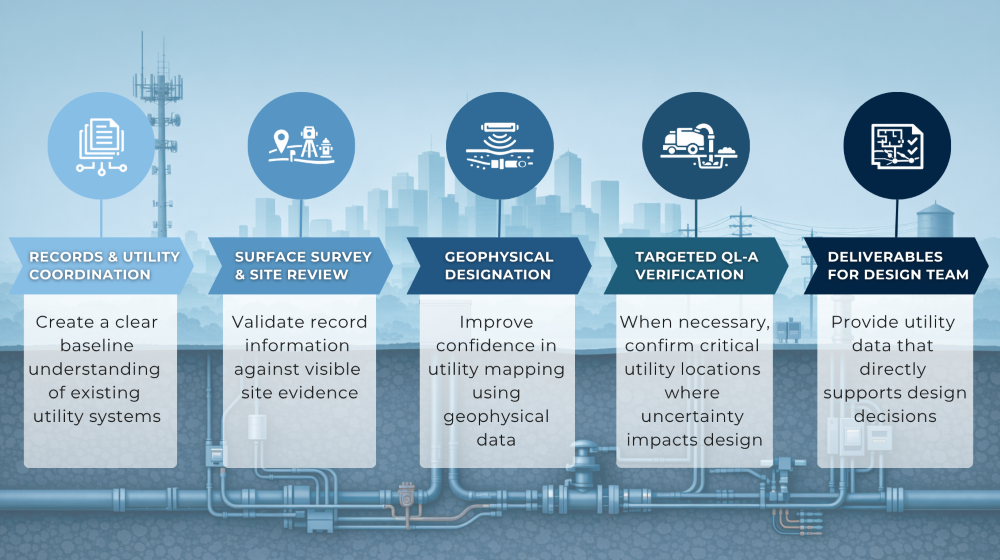
QL-D: Records Information
Records research is the starting point for most utility investigations. It helps establish context, but record-based information is often incomplete, outdated, or inconsistent. It’s useful to assist in field data collection and to fill in the blanks for utilities that are identified on records but cannot be identified in the field using the methods prescribed in the investigation scope. At 4Sight we use QL-D to give crews an initial idea of what utilities will be present, fill in information gaps, and plan where additional field investigation may be needed.
QL-C: Surface Feature Correlation
Quality Level C adds field context by correlating visible above-ground utility features with available utility records. It improves the usefulness and certainty of record information for utility segments that can be further refined using surface features. We use QL-C mostly for sewer segments where inverts can be collected at upstream and downstream chambers then tied together with records information. We may also use it for water or gas where valves may be visible, but we are unable to obtain a QL-B signal. This helps to improve certainty of data and improve the reliability of the overall utility picture.
QL-B: Geophysical Designation
For many projects, this is the desired quality level to be achieved for most utilities’ alignments present in key areas of the project. Using the geophysical designating process also allows field technicians to identify utilities that may not appear on records and otherwise would not have been shown on drawings. QL-B often provides the level of utility information needed for meaningful design progress, but it may still leave unanswered questions about depth or exact utility position in high-risk areas. 4Sight applies geophysical designation to move projects beyond assumption-based mapping and toward field-supported utility intelligence that designers can use with more confidence.
QL-A: Test Holes and Vacuum Excavation
Quality Level A is the highest-confidence level of utility investigation. It is not necessarily required everywhere. Its value comes from targeted verification in places where uncertainty carries the greatest impact. We install test holes at key locations to accurately capture utility depth, alignment, material, and size. Using QL-A strategically, we target and expose critical utilities, significantly reducing uncertainty and improving project confidence.
How We Deliver ASCE 38 Utility Investigations
ASCE 38 is most effective when it is treated as a coordinated investigation process, not a checklist item. Our approach is built around project risk, site conditions, and the quality of information needed to support real design decisions.
What Makes Our ASCE 38 Approach Different
A utility investigation is only valuable if it improves decisions. At 4Sight we focus on:
- Integrating multiple investigation methods, including state of the art techniques such as Multi-Channel GPR
- Matching investigation scope and cost to project risk
- Clearly communicating uncertainty on project drawings
- Delivering design-ready information that was created under constant review of a Professional Engineer
- Supporting engineers and designers needs, not just locating utilities
We don’t just locate utilities; we become an integrated part of your design team to help you understand how much you can trust the data.
Projects Where ASCE 38 Adds the Most Value
ASCE 38-aligned utility investigation is especially valuable where underground conditions can influence design decisions, phasing, utility coordination, or construction risk.
- Roadway reconstruction and corridor improvement
- Municipal infrastructure and capital works projects
- Water, sewer, and storm upgrades
- Utility coordination for site development
- Rail, bridge, and highway crossings
- Congested urban or industrial corridors
- HDD and trenchless planning
- Pre-design and preconstruction utility risk assessment
FAQS
4Sight News
Please join us in welcoming Moe Nayef. In his role as Project Utility Engineer, Moe will support the coordination and delivery of utility work, helping project teams identify […]
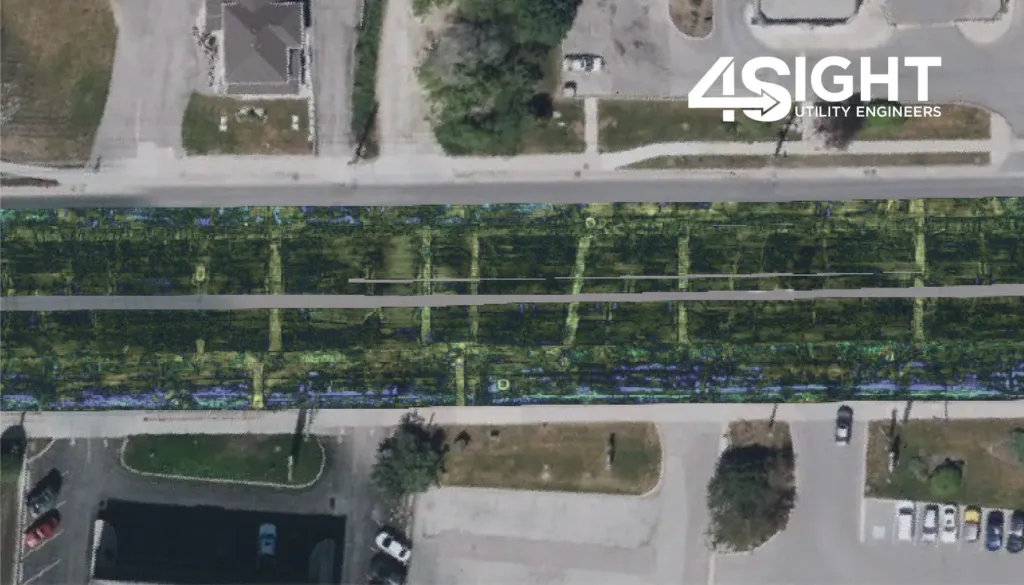
On legacy transit corridors, some of the most significant project risks are hidden underground. Unknown utilities, abandoned trenches, undocumented infrastructure, and legacy construction can influence design decisions, budgets, […]

Contact
P: 1 (289) 385-3303
E: info@4SightUE.com
Address
Headquarters
4Sight Head Office
2100 Forbes Street, Unit 1
Whitby, ON
L1N 9T3
126 Market Street
Commercial Unit #1
Philadelphia,
PA 19106
© 2026 All Rights Reserved | Contact Us | Accessibility | Privacy Policy | Terms of Use