
4Sight Utility Engineers supports clients with precise utility locating, advanced mapping, and structured investigation processes. Our team delivers the clarity needed to move projects forward with confidence

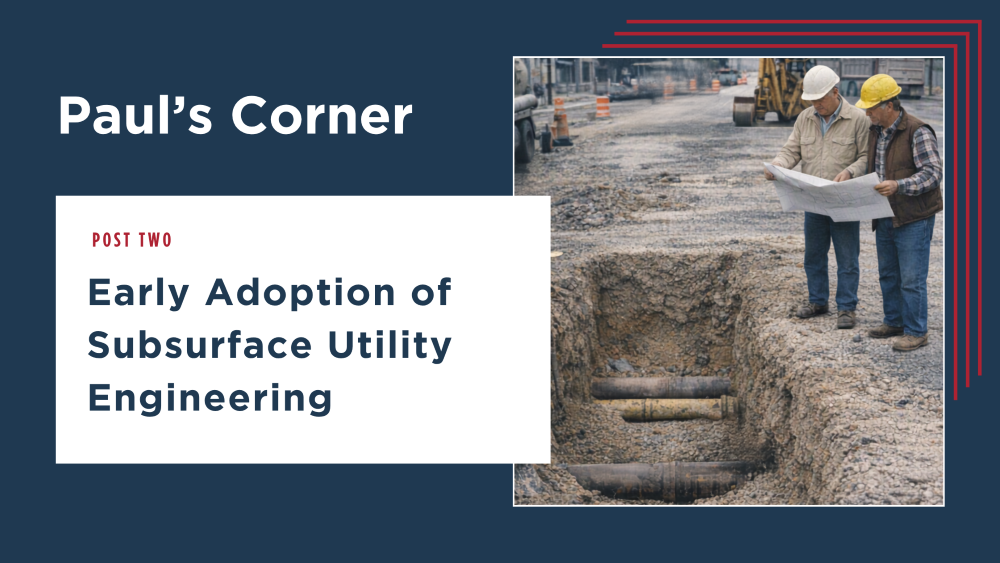
Subsurface Utility Engineering (SUE) did not gain recognition through theory alone. Its early acceptance came from demonstration on active projects where inaccurate utility information had already created risk. In the early 1980s, several important events took place that began to show that a disciplined approach to underground utility investigation could change how infrastructure projects were planned and delivered.
These early efforts moved SUE from a developing idea into a service that public agencies could evaluate, adopt, and rely on.
The First Major Case Study That Demonstrated Measurable Value
Jim Anspach documented a case study in his history of SUE that was probably the first BIG case study showing the value of SUE. It goes like this:
Garon Stutzman approached the Virginia Department of Transportation (VDOT) in late 1983 with the concept of designating all the utilities on a highway project in the design stage so that designers could avoid them on paper when possible. VDOT saw the potential and allocated $10,000 for a trial project. The selected project was a massive road reconstruction in Crystal City (VA) traversing the Pentagon and National Airport areas. Construction plans were already drawn, with utilities plotted from owner records and supposedly “certified” as correct by the utility companies. So-Deep designated the utilities and a VDOT crew surveyed the designations and plotted them on the plans. There were vast differences. So-Deep then performed approximately 100 test holes to prove their designations were accurate and to further identify the potential conflicts. On the record, VDOT stated to the Federal Highway Administration (FHWA) that over $1 million dollars in savings to the tax payer were realized. Off the record, the figure was $7 million or more.
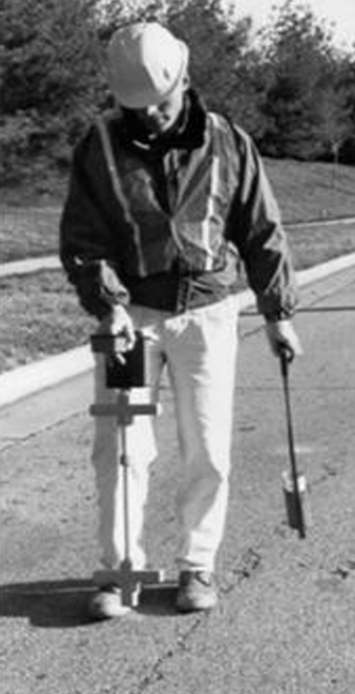
This project established a clear outcome: investing in accurate utility information before construction could prevent cost escalation and schedule disruption.
Early Contracts That Established a New Service Model
Following early project success, public agencies began to formalize how utility investigation services were procured.
In 1982, the County of Fairfax, Virginia, entered into a contract with So-Deep for locating (test holes). This was the first instance of a governmental body entering into a task-order basis contract for locating utilities. The County of Arlington, Virginia, soon followed. In 1983, as discussed previously, the Virginia Department of Transportation (VDOT) entered into a contract for designating (geophysical methods) and locating (test holes) utilities on a highway project, and in 1985, VDOT initiated a statewide contract with So-Deep for designating and locating work, the first such contract in the nation.
It was found early on that the utility companies had very poor records on the locations of their subsurface facilities and consequently the one-call markings were often inaccurate or missing. Jim Anspach was quoted at the time as saying:
“We were determined to get good utility information in spite of not having utility records that were accurate and reliable; we repurposed geophysical technology, searched the world for new equipment, and replaced ‘pipe witching’ with science and limited utility exposure.”
Defining Designating and Locating as Separate Functions
At some point, questions arose regarding what to call the services that So-Deep was providing. Jim Anspach and Jeff Oakley, a Penn State physics graduate, did some brainstorming and developed the terms “designating” and “locating” to more accurately differentiate these functions. They rationalized that a utility was not located until it was exposed; until then, their existence and approximate location were designated by interpreting an energy field of some kind.
Building Quality Through In-House Survey Control
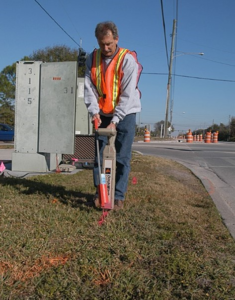
As demand grew, maintaining consistency in deliverables became increasingly important. Accurate field data needed to be translated into reliable drawings that designers could use with confidence.
At the request of VDOT, So-Deep hired an experienced land surveyor (Mike Fisher) to develop its own survey capability and to manage the first VDOT contract. Whereas many future providers subcontracted the survey work to local companies, having its own in-house survey unit provided So-Deep with better control over the quality of the work and was a differentiator in later years when competing with other providers.
The Shift Toward Recognized Professional Practice
Maryland’s Washington Suburban Sanitary Commission (WSSC) entered into a contract with So-Deep in the mid-1980s to provide designating and locating services. Maryland statutes dictated that any information depicted on plans through survey work associated with these services, when used by a public agency, must be “sealed” by a registered professional. As a result, So-Deep added a professional engineer (Lou Ostendorff) to seal their deliverables to clients. This was the first time any portion of the designating and/or locating work was required to be endorsed by a registered professional. This requirement set the stage for future development of SUE as a professional service rather than a contractor service.
Professional Liability and the Recognition of Risk
As SUE projects increased in scale, the associated risks extended beyond physical damage during construction. Securing professional liability insurance for this work proved difficult. Jim Anspach gave his insights to Paul:
"It was virtually impossible for So-Deep to remain self-insured when performing millions of dollars’ worth of what had been ruled professional services, and professional liability insurance proved difficult to get when one was doing what had never been done before. No insurance company was willing to take on the 'designating' aspect of SUE, just the traditional survey of the designating. So-Deep even went to Lloyds of London to make the attempt. Finally, CNA insurance stepped up and stated that if So-Deep was willing to pay for one of CNA’s executives to observe every aspect of field and office operations for a period of time (it lasted more than a month) and if So-Deep’s designating services were deemed “insurable” after that evaluation, CNA would offer professional liability insurance for the entire package of what So-Deep was offering. Thus, in 1988, CNA insurance company issued a professional liability policy to So-Deep that covered all aspects of its operation, not just the survey aspects. This was the culmination of years of effort by So-Deep’s General Counsel, Harley A.J. “Bucky” Methfessel. By having this insurance, So-Deep was able to cover negligent errors or omissions in their services that could result in project delay claims, redesign costs, extra work order claims…more than just covering the cost of repairs if a utility was damaged during construction. Years of successful operations without claims from So-Deep set the stage for other insurance companies to provide similar coverage to the newer SUE firms that in a few years would be entering the market.”
The Ongoing Impact on Infrastructure Projects
The practices introduced during this period continue to influence how infrastructure projects are delivered. Early efforts to improve utility data quality have evolved into comprehensive approaches that integrate field investigation with design and construction planning.
The emphasis on accuracy, documentation, and risk management remains central to SUE. These principles guide how project teams reduce uncertainty and avoid disruption.
Understanding how these methods developed provides context for current expectations. The systems used today are built on the lessons learned during these early projects, where each advancement addressed a specific gap in how underground utilities were managed.
Ready to find out more?




Contact
P: 1 (289) 385-3303
E: info@4SightUE.com
Address
Headquarters
4Sight Head Office
2100 Forbes Street, Unit 1
Whitby, ON
L1N 9T3
126 Market Street
Commercial Unit #1
Philadelphia,
PA 19106
© 2026 All Rights Reserved | Contact Us | Accessibility | Privacy Policy | Terms of Use