HISTORY OF SUBSURFACE UTILITY ENGINEERING

Post-83 – SUE for Municipalities

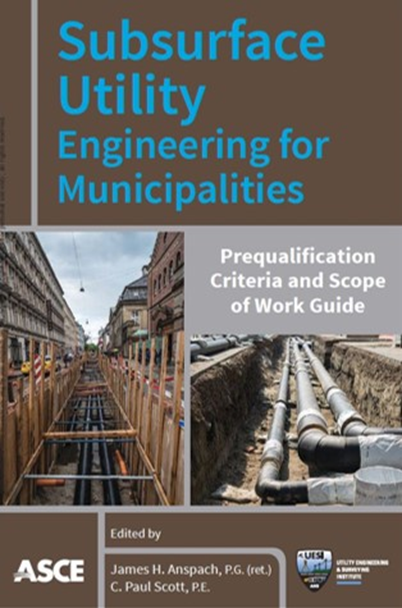
Subsurface Utility Engineering for Municipalities is an ASCE publication that all SUE practitioners should have and read.

 Jim Anspach has provided some interesting background information in this document that pertains to ASCE 38-22 (Standard Guideline for Investigating and Documenting Existing Utilities) but is not contained in that document. Also included only in this document, as shown in the subtitle, are Prequalification Criteria and a Scope of Work Guide.

 For those of you that like history, it may interest you to know that this is actually the third edition of the document.  The first edition was a manual written by Jim Thorne (co-author of the Highway/Utility Guide) in 1997 for the American Public Works Association (APWA). In about 2005, Al Field who was Chair of the APWA’s prestigious UPROW Committee (Utilities and Public Right-of-Way) asked Jim Anspach and Paul Scott to update Jim Thorne’s manual, which they did and it was distributed widely to APWA members. Again, in about 2015, Al asked Jim and Paul to update it again. They did, and it was subsequently published by the American Society of Civil Engineers (ASCE) and is available from ASCE today.

 I hope you have a copy of Subsurface Utility Engineering for Municipalities. It’s full of lots of good information about SUE.

 ——————–

SUE ASSOCIATION CONFERENCE
NASHVILLE, TENNESSEE
SEPTEMBER 17-19, 2024.

Hope You Can Attend

HISTORY OF SUBSURFACE UTILITY ENGINEERING

Post-84 – Value of SUE on Individual Projects

Several weeks ago, we looked at SUE studies performed by Purdue University, University of Toronto, and Pennsylvania State University. These studies projected savings of $3.62, $3.41, and $22.21, respectively, for every $1.00 spent for SUE. These savings came primarily from the elimination of unnecessary utility relocations and reductions in delay claims.

Last week we looked at “Subsurface Utility Engineering for Municipalities,” which is a document that contains the results of cost studies on highway, transit, airport, and other individual projects. Below are five examples.

1. On a major highway project in the early 1990s, the Virginia DOT’s design consultant used SUE data and determined that conflicts with utilities would occur at 75 sites. As a result, design changes were made and 61 of the potential conflicts were eliminated. By making these changes, $731,425 worth of utility adjustments were avoided, whereas the cost of digging the test holes was only $93,553, resulting in a savings of $637,872.

2. The North Carolina DOT evaluated four of its early SUE projects and found that the DOT saved $420,000.00 and paid SUE firms only $77,550.96, thus saving $5.42 for every $1.00 spent. It was concluded that it was very cost effective to use SUE on a regular basis, and that SUE provided tremendous benefits for the DOT, the utility companies, the consultants, and the public.

3. The Ontario Ministry of Transportation’s (MTO) first SUE investigation was performed prior to designing an interchange improvement project. The investigation identified several discrepancies in the record data that could have caused major delays and cost increases. The MTO realized savings of over $62,000 due to the completion of the SUE investigation and had a return on investment of $2.48 for each $1 spent.

4. On a Georgia DOT project a median barrier was installed on a stretch of highway leading to the beach. This highway had high accident ratings, drainage problems, and turtle crossings. SUE information enabled the design consultant to strategically place the wall and equip it to reduce accidents and accommodate both the drainage and the turtles.

5. Designers on a large design-build project in Texas used SUE information and developed plans to avoid relocating several high-pressure pipelines and as a result prevented project delays and saved $3.0 million.

The above, and many more case studies contained in “Subsurface Utility Engineering for Municipalities” were extremely important back in the early days when the value of SUE was unknown. They are not as important today because experience has shown SUE to be a cost-effective best practice on projects involving excavation and subsurface utilities.

Please Don’t Forget:

  The SUE ASSOCIATION CONFERENCE in Nashville on September 17-19.

John Palatiello, Executive Director, SUEA

Post-87 – History of SUE Association

The SUE Association was the brainchild of John Berrettini and Mike Maguire, both of A/I/Data in Baltimore. They contemplated the idea in 2009 and had intermittent discussions with colleagues in other firms, but no action was taken until 2014 when  Berrettini and Justin Klein of the Klein Agency met with John Palatiello to discuss the process of creating an association.

Berrettini and Klein knew Palatiello from his role as Executive Director of the Maryland Society of Surveyors and were aware of his track record as Executive Director of MAPPS, the trade association of photogrammetry and geospatial firms, Administrator of the Council on Federal Procurement of Architectural and Engineering Services (COFPAES), and other association clients he served in the surveying, mapping, and A&E field.

Klein retained Palatiello to do a feasibility study and a dinner meeting of SUE firms in the Middle Atlantic region was convened in Bethesda, Maryland in March of 2015 in which different options for an association were presented and discussed. The representatives of the seven firms present (A/I/DATA, Accumark, JMT, KCI, Klein Agency, AMT, Insight, and AB Consultants) all agreed that next steps should be taken. That resulted in the compilation of names and contact information for principals in SUE firms and the dissemination of an online questionnaire.

Ultimately an “interest meeting” was held in Washington, DC in July of 2018. At that meeting, Palatiello and Berrettini presented a “straw man” of a national association, with a membership of private sector SUE service firms as Regular Members, with suppliers and related firms as Associate Members. Those present endorsed the proposal. As a result, bylaws were adopted and the first board of directors and officers were elected, with Berrettini selected as the first President and Palatiello was named Executive Director. Some of the members of the first board of directors are pictured.

The SUE Association was up and running. More about it and what it was doing will be discussed next week.

HISTORY OF SUBSURFACE UTILITY ENGINEERING

I’ve been told that the SUEA Conference was a GREAT conference. My thanks to all the organizers, moderators, speakers, panel members, and attendees for making it happen.

The Subsurface Utility Engineering Association (SUEA) was officially launched on July 26, 2018. Once convened, John Palatiello (Executive Director), John Berrettini (President of Board of Directors), Nick Zembillas and other Board Members played significant roles. Also, Jim Anspach, who was a speaker at the “kick off” conference. Meetings with Federal agencies and members of Congress ensued, a membership campaign was initiated, and a second conference was held a year later, again in Washington, DC.

Shortly thereafter, COVID hit, putting in-person events on hold and threatening the growth of the fledgling new association. Webinars were held to keep the members engaged and to help recruit new firms to the membership throughout the pandemic. In addition, SUEA worked with the Department of Homeland Security and the Governors of several states to assure that SUE services were defined as critical and essential, thus enabling businesses to remain open and employees to keep working throughout the pandemic. Also, another in-person conference was held in Denver in the summer of 2022. More than 100 people attended and an exhibit hall was sold out.

Today. in addition to growing the membership base to now include more than 70 organizations, SUEA has accomplished the following:

  • Hosted five national conferences.
  • Worked with the Department of Homeland Security and the Governors of several states to assure that SUE services were defined as critical and essential, enabling businesses to remain open and workers to keep working throughout the pandemic.
  • Implemented webinar programs for business, policy, and technical continuing education.
  • Worked with Congress and Federal agencies on infrastructure legislation, PHMSA reauthorization, and a project labor agreement exemption.
  • Worked with the Department of Homeland Security on a national underground asset register, with the U.S. Army Corps of Engineers on its SUE requirements; and with NCEES and several firms to provide more clarity on the performance of SUE services and the status of state PE and LS licensing laws governing the practice.
  • Was part of efforts to protect GPS from spectrum interference, working with Congress and other stakeholders.
  • Was involved in the implementation of the Infrastructure Act, as well as on Federal procurement reform.
  • Was involved in several states that are looking at potential legislation similar to the law enacted in Colorado.

In 2022, SUEA signed an MOU with the UESI of ASCE agreeing on respective roles and responsibilities and cooperative activities so as to avoid unnecessary duplication. This was BIG. These are the groups that will be working together on major activities in the future, possibly including the next ASCE 38.

Project Manager

We are looking for passionate professionals with a SUE background who can come and join our team.  There are opportunities for both Sr and Jr positions.  Candidates should have exceptional customer skills and expertise managing SUE projects.  Candidates may have a P.Eng, EIT, CET or C.Tech status.

Apply Below


SUE Technician

We are looking for passionate professionals with Utility Locating experience.  There are opportunities for Lead positions as well as Sr and Jr positions.  Candidates should have expertise locating a variety of Utilities using a wide range of geophysical equipment (PCL, GPR, etc.).

Apply Below


CAD Technician

We are looking for passionate professionals to join our team. Candidates should have expertise in either Microstation or AutoCAD suites of software.  Candidates may have a CET or C.Tech designation.

Apply Below


Utility Coordinator

We are looking for passionate professionals with a Utility background to come and join our team.  There are opportunities for both Sr and Jr positions.  Candidates should have expertise a variety of areas (Telecom, Electrical, Gas, Municipal) and with major infrastructure projects.

Apply Below


Utility Engineer

We are looking for passionate Professional Engineers with a Utility Background who can come and join our team.  There are opportunities for both Sr and Jr positions.  Candidates should have expertise in either Telecom, Electrical, Gas, Municipal or a combination of them all.  Candidates should have a P.Eng or EIT designation.

Apply Below